
Find the chance of one event, of two events together, or of an event over repeated tries, with every formula worked out.
Loading calculator…
This free probability calculator gives each answer as a decimal, a percent and an exact fraction, and shows the formula with your numbers filled in. Type a probability as 0.25, 25% or 1/4.
How to use this probability calculator
- One event: enter the number of favorable outcomes and the total number of outcomes. You get P(A), the chance it does not happen, the odds and the chance as 1 in N.
- Two events: enter P(A) and P(B), then choose whether the events are independent or mutually exclusive. You get P(A and B), P(A or B), P(not A), P(not B), exactly one, neither, A only and B only.
- Repeated tries: enter the chance for one try and the number of tries. You get the chance of at least once, every time and never, plus how many tries you need for a 50%, 90% or 95% chance.
Each tab has example buttons (coins, dice, a deck of cards) that fill in the numbers for you, so it also works as a simple probability calculator, a dice probability calculator or a random chance calculator for games and homework. Every answer is also shown as a percent, so you can use it as a percentage chance calculator too. For counts at an average rate or draws without replacement, see all probability and distribution calculators. To find the expected value and standard deviation of your own table of outcomes, use the calculator that builds a distribution table.
How to find probability
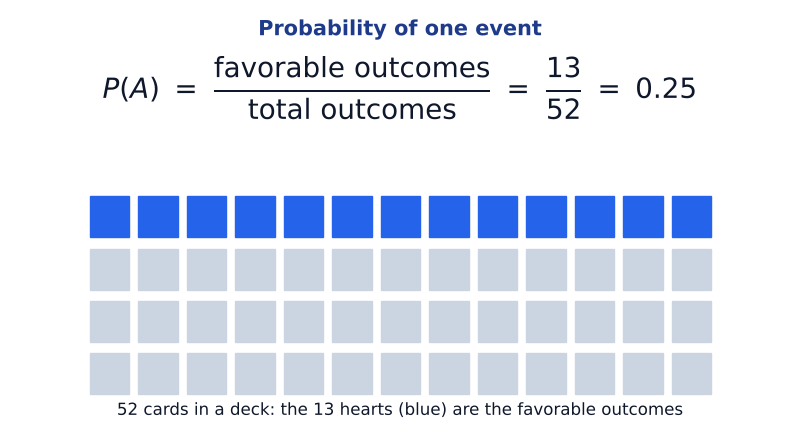
To calculate probability for one event where every outcome is equally likely, divide the number of favorable outcomes by the total number of possible outcomes. This basic probability formula is how to do probability for most homework problems:
P(A) = favorable outcomes ÷ total outcomes
Example: a standard deck has 52 cards and 13 of them are hearts. The probability of drawing a heart is 13 ÷ 52 = 1/4 = 0.25, or 25%. The chance of not drawing a heart is 1 − 0.25 = 0.75. To calculate odds, compare favorable outcomes with unfavorable ones and simplify: 13 hearts against 39 other cards gives odds of 13 : 39 = 1 : 3. The odds against are 3 : 1. Odds are not the same as probability: odds of 1 : 3 mean a probability of 1/4, not 1/3.
Probability always runs from 0 (impossible) to 1 (certain). To calculate probability from a percent, divide by 100: 25% is 0.25. The chance that the event does not happen, 1 − P(A), is called the complement of A and is written A′ or Aᶜ.
How to calculate the probability of two events
With two events A and B, the answer depends on how they are related. Independent events do not affect each other, such as two separate dice. Mutually exclusive events cannot happen together, such as rolling a 1 and a 2 on the same die. Textbooks write the probability of A and B as P(A ∩ B) (the intersection) and the probability of A or B as P(A ∪ B) (the union).
| You want | Symbol | Formula |
|---|---|---|
| A and B | A ∩ B | P(A) × P(B) if independent; 0 if mutually exclusive |
| A or B (or both) | A ∪ B | P(A) + P(B) − P(A and B) |
| Not A (complement) | A′ | 1 − P(A) |
| Exactly one of them (exclusive or) | P(A or B) − P(A and B), the same as P(A) + P(B) − 2 × P(A and B) | |
| Neither | (A ∪ B)′ | 1 − P(A or B) |
Example with two dice, A = first die shows 6 and B = second die shows 6:
- P(A and B) = 1/6 × 1/6 = 1/36 ≈ 0.0278
- P(A or B) = 1/6 + 1/6 − 1/36 = 11/36 ≈ 0.3056
- P(exactly one) = 11/36 − 1/36 = 5/18 ≈ 0.2778
- P(neither) = 1 − 11/36 = 25/36 ≈ 0.6944
Press the “Two dice both show 6” example and the calculator shows the same rows. Its probability bar splits the 100% into both, A only, B only and neither, so you can see that the four parts always add up to 1.
If the events are dependent, for example drawing two cards without putting the first one back, the second chance changes after the first draw and P(A and B) = P(A) × P(B given A). This calculator covers independent and mutually exclusive events only. To find P(A given B) or work out P(B given A) from a table or with Bayes’ theorem, use the calculator for the probability of A given B. To find the chance of a certain number of successes in such a draw, use the hypergeometric tool for draws without replacement.
Probability of at least one success in several tries
It is easier to work out the chance that something never happens and subtract it from 1. If one try has probability p, then over n independent tries:
P(at least once) = 1 − (1 − p)ⁿ
Example: the chance of rolling at least one 6 in 4 rolls is 1 − (5/6)⁴ = 1 − 625/1296 = 671/1296 ≈ 0.5177, a little better than even. This probability calculator also works backwards: with a 1 in 6 chance you need 4 rolls for a 50% chance of at least one 6, 13 rolls for 90% and 17 rolls for 95%.
This tab answers “at least once” questions. For the chance of exactly 3 successes in 10 tries you need the binomial distribution, which is a different calculation. If the events happen at a steady average rate, such as calls per hour, the Poisson calculator for event counts gives the chance of an exact count.

Theoretical vs experimental probability
Theoretical probability comes from counting outcomes, as this calculator does: a fair coin lands heads with probability 1/2. Experimental probability (also called empirical probability) comes from what actually happened: if you flip a coin 50 times and get 28 heads, the experimental probability is 28 ÷ 50 = 0.56.
The two get closer as you repeat the experiment more times. Experimental probability is simply a proportion, the same as the mean of your results scored 1 for heads and 0 for tails, which the mean tool can find for a long list of outcomes.
Probabilities for measurements on a bell curve, such as heights or test scores, work differently: they come from the normal distribution. Use the normal-curve z table for those, and the all-in-one statistics calculator to summarize a data set first.
Probability calculator FAQs
What is probability?
Probability is a number from 0 to 1 that says how likely an event is. 0 means it cannot happen, 1 means it is certain, and 0.5 means it is as likely to happen as not. It is often written as a percent (0.25 = 25%) or a fraction (1/4).
What is the probability of rolling two sixes?
The two dice are independent, so multiply: 1/6 × 1/6 = 1/36, about 0.0278 or 2.78%. The chance that at least one die shows a 6 is 11/36, about 30.56%.
How do I turn odds into a probability?
Odds of 1 : 3 mean 1 favorable outcome for every 3 unfavorable ones. Add the two numbers to get the total, then divide: 1 ÷ (1 + 3) = 0.25, or 25%.
Can a probability be more than 1?
No. A probability is always between 0 and 1 (0% to 100%). If you get more than 1, two events were probably added when they can happen together, so the overlap P(A and B) was counted twice.
How do I calculate the chance of at least once in Excel?
Use =1-(1-p)^n. For a 1 in 6 chance tried 4 times, type =1-(1-1/6)^4 and Excel returns 0.5177, the same answer this calculator gives.
Easy Stat Calc · Results checked against Python, R and Excel · Last updated November 6, 2026 · Methodology